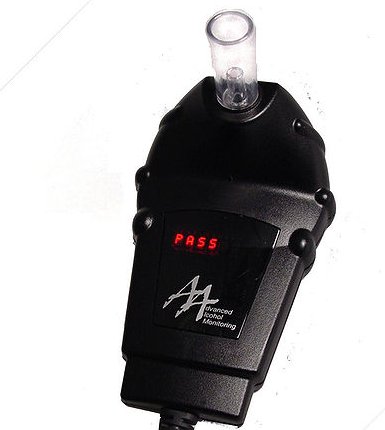
The Government wants to install alcohol detectors in cars, but is that a good idea?
Schumer calls for alcohol detectors in vehicles
WASHINGTON — Sen. Charles E. Schumer said Thursday he’ll push for legislation to boost alcohol-detection technology in cars, which he said could greatly reduce drunk driving — especially for repeat offenders.
Basically the idea here is to develop technology that won’t allow a car to start if the driver has a BAC over .08. At first the technology will be voluntary and you can rest assured that the proponents of this bill plan to make this measure mandatory at some point. Senator Schumer goes on to say:
Anybody who’s opposed to this should be ashamed of themselves.
Well Senator Schumer I am opposed to this measure and I am not the least bit ashamed because I have facts that show why this is a bad idea.
1. Installing Alcohol Sensors on Cars Treats Everyone Like a Criminal
This measure is another way of saying, “Prove your innocence before you can drive”. I have blogged about the presumption of guilt in a DUI before and this is another measure that proves my point. Legislators backed by powerful lobbies are pushing through new laws that go against the fiber of civilized society and justice, the presumption of innocence- all for the benefit of private industry, meaning those who make the inhibition devices. There is A LOT of money there if it becomes mandatory. Here you can be perfectly innocent but you have to prove that before you can use your own car. What about false positives? What if the machine malfunctions? Why not just have a police officer follow me around all day to make sure I don’t murder someone? Wouldn’t that reduce the murder rate (unless someone flips out on the cop-stalker)? Why not search all of my grocery bags at the supermarket to make sure I didn’t shoplift? Where do you draw the line?
2. Current “Advanced” Technology is Pretty Crappy
After thousands of Pennsylvania DUI cases and many hours of training on breath testing technology and all forms of analytical chemistry, I have come to the educated and settled conclusion that the technology we currently have that could be placed in a car and is not invasive, but rather is passive, is total garbage. The machines are quirky and are not even specific to ethanol which is drinking alcohol. You can have an illegal BAC level after eating a slice of bread with some forms of testing:
or if your phone rings:
Last week I blogged about how Faulty Machines Lead to 400 DUI Convictions in D.C. Imagine having to drive your wife to the maternity ward or a critically ill next door neighbor to the hospital and the car doesn’t start due to a false positive. It happens more often than you might suspect. On top of that you are asking car manufactures, who keep recalling vehicles due to production faults, to mass produce these devices. Are they capable of doing it right? Who will calibrate them properly?
3. People Will Still Find Ways Around It
People are resourceful and will always find workarounds which will deem these devices in all practical effects useless. Its like when offices use a firewall to try to keep employees off Facebook and YouTube but those who want to will always find a way around it.
In my experience, I see this as a political tactic to appease special interest groups and a way for folks to make A LOT of money. I am of the opinion that laws should be based on hard and most importantly, objective evidence and validated science, not political pressure or profit.
-Justin J. McShane, Esquire, Pennsylvania DUI Attorney
I am the highest rated DUI Attorney in PA as Rated by Avvo.com
You can follow me on Twitter, Facebook or Linkedin

Board Certified Criminal Trial Advocate
By the National Board of Trial Advocacy
A Pennsylvania Supreme Court Approved Agency
Lisa Bloom of CBS and CNN interviews Pennsylvania DUI Attorney Justin McShane. In this interview ignition interlock devices issues and malfunctions are discussed. Also what makes the McShane Firm different from all other Pennsylvania DUI law firms is discussed. The question of will alcohol inpatient treatment help me is addressed. Finally, Driving Under the Influence of Drugs is also discussed.
-Justin J. McShane, Esquire, Pennsylvania DUI Attorney
I am the highest rated DUI Attorney in PA as Rated by Avvo.com
You can follow me on Twitter, Facebook or Linkedin
.jpg)
Board Certified Criminal Trial Advocate
By the National Board of Trial Advocacy
A Pennsylvania Supreme Court Approved Agency
Attorney Pat Barone is a nationally recognized DUI attorney and professor. I highly recommend reading his posts as he is a editor and author of the DWI Journal and posts some very well written technical and timely blog posts. In his latest post entitled Will Technology End Drunk Driving? He raises some very important questions involving the evolution of technology and its implementation in society.
He writes:
As fast as technology has moved in the past 20 years it’s a wonder it’s even possible to drive drunk today. One would think that governments everywhere would have required car manufacturers to install something in cars that would disable them if the driver was drunk.
He identifies that the current wide spread technology of interlock devices which are built on fuel cell technology are totally inaccurate as they are not specific as to alcohol.
Then he next examines the developing technology of Raman Spectoscopy.
He points to the following:
For example, one such company is well on the road to implementing a fascinating new device that may perhaps represent the next generation of body alcohol measuring devices.
The name of the company is TruTouch Technologies, Inc., a company based out of Albuquerque, New Mexico is a spin-off of InLight Solutions, Inc. They have developed a non-invasive, purportedly simple to use machine which can determine an individual’s bodily alcohol concentration using Near Infrared (NIR) Spectroscopy.
The device, which they call “The TrueTouch 1100” is about the size of two shoe boxes placed end-to-end and looks a bit like a standard grocery store cash register. In order to measure BAC, the driver need only be directed to place his or her arm across a cradle located on the top of the device. Using NIR spectroscopy, the device measures BAC by shining a light into the driver’s arm then measuring the reflected light.
We will see. All that I know is that over the course of human history for every technological advance that comes forward that prevents someone from trying to do something, there is likely someone working equally as hard, if not harder, to overcome that latest piece of technology. There will likely be no end to drunk driving, no matter what we do. Perhaps that is because we are framing this all wrong. Maybe what we, as a society, should seek is a way to ensure fair detection and a fair prosecution of those who violate the law where there are no false positives and the error rate is as near zero as possible. It is highly unlikely that any single device will lead to the end of DUI, but an end to false conviction for DUI can perhaps be an achievable goal.