We all want to trust the police and see them as upright protectors of justice. While many police officers are very professional and take their responsibility very seriously, there are others who are corrupt and use unscrupulous tactics that harm the common citizen.
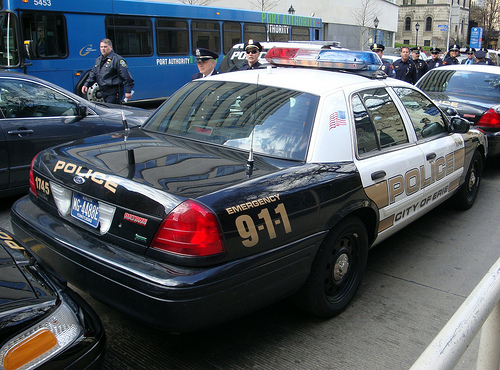
Bad cops exist everywhere and there is no shortage of them in Pennsylvania. Some of them will even go as far as to lie under oath:
Ex-cop admits lying in DUI case
HERMITAGE — As a citizen, Raymond Bogaty wants to believe the police.
“We all want to believe the police,” he said.
But, as Mercer County Public Defender, Bogaty has occasionally suspected that a story told by a policeman has not been the whole truth.
“I’ve been doing this for 37 years,” he said. “You always have concerns about truthfulness. You, at times, suspect the truth is not being told.”
Still, it’s rare to catch a policeman in a lie, or to get an admission that someone has lied, he said.
That unusual event occurred Tuesday when Mercer County District Attorney Robert G. Kochems and Hermitage Police Chief Patrick B. McElhinny released statements saying that Hermitage patrolman Dennis Best had admitted lying under oath in a 2008 case.
Criminal justice is intrinsically a human endeavor and due to the lack of transparency and oversight when it comes to the police, the situation is ripe for honest mistakes, purposeful and conscious misleading actions (lies) and even corruption. This can lead to false conviction if we do not successfully expose the lies and mistakes in the police officer’s account. This is why it is important to have an attorney who had trial experience in DUI cases and who has the guts to cross-examine the police.
If you feel the police have violated your rights call The McShane Firm to protect your freedom and liberty. Call 1-866-MCSHANE.
Under New Pennsylvania Laws: A DUI Conviction for Anyone in Your Home Can Affect Your Custody Rights
As I have often mentioned on this blog, the penalties for a Pennsylvania DUI are very severe and they last a lifetime. Unfortunately, these penalties are only getting more and more severe and have serious ramifications on other, seemingly unrelated aspects of a person’s life. Recent changes to Pennsylvania’s child custody laws have once again put these DUI penalties into the spotlight. Under the new laws, people with a prior DUI conviction will have that taken into consideration when determining child custody rights, even if the DUI had nothing to do with the child and even if it was many years ago. Even more absurdly, prior DUI convictions of anyone living in that home will also be taken into consideration:
Pennsylvania modernizes child-custody laws
At the end of January, new child custody laws went into effect in the commonwealth. The new custody laws had been considered in Harrisburg for more than 10 years and were finally signed into law by then-Gov. Ed Rendell at the end of last year.
These new custody laws govern all custody actions filed on or after Jan. 24. Custody actions filed before that date are still governed by the old laws.
There are at least four major changes to the custody laws that may affect you if you become involved in a custody action. First, the new law requires that, when a parent seeks custody of a child or children, the judge must determine if that parent, or anyone living in that parent’s household, has ever been convicted of one of a number of specific crimes listed in the new laws. Most importantly, DUI and possession of a controlled substance now are among the specific crimes listed.
The judge must decide if the parent with the conviction, or a person with the conviction who is living with the parent, poses a threat of harm to the child or children before making any custody order. These requirements are a significant change to Pennsylvania custody laws and must be considered before starting a custody action.
This is another example of the far-reaching effects of a DUI conviction and more reason to find a professional Pennsylvania DUI attorney to help clear your name and protect your rights.
If you have any questions about how a DUI may influence your custody rights, please call 1-866-MCSHANE.
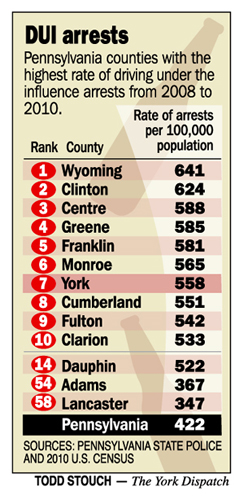
I recently came across some statistics about DUI arrests in York County:
York County ranks seventh in Pa. DUI arrests
York County had one of the highest rates of DUI arrests in the state from 2008-10.
But authorities aren’t sure whether that means the number of people who decided to drive under the influence is up or if police are getting better and more vigilant at tracking down offenders.
See the troubling thing with arrest numbers is they don’t tell the whole story. For example if police officer A makes 100 DUI arrests of which 60 resulted in convictions while officer B made 50 DUI arrests in which 48 resulted in convictions, who is the better officer? If you go by just arrest numbers, then officer A. This why arrest statistics can be very misleading.
Another aspect to take into consideration is today there are more DUI focused patrols and DUI checkpoints in PA than ever before. One of the problems with this approach is officers are “geared up” to make DUI arrests and this can lead to biased judgment calls and higher frequency of false arrests. Drowsy and clumsy drivers end up getting charged with DUIs because that is what the officers on those patrols are psychologically set to look for.
DUI is a problem that effects many lives and has many victims. There are those who are injured or killed in DUI related accidents and their loved ones and also those who are falsely arrested for DUI. In both cases you have innocent people who lives have been shattered needlessly and senselessly. My only wish is that we could use law enforcement practices that protect innocent citizens from both outcomes: being a victim of a DUI accident and being a victim of a false DUI arrest.
If you are a victim of a false DUI arrest, please call the PA DUI attorneys at The McShane Firm for a free case consultation at 1-866-MCSHANE.
DUI are cases are very complex. Most of the time, the only evidence is the opinion of a bias police officer and a reading from a blood or breath test. Unfortunately, this opinion evidence coupled with bad technology leads to far too many false DUI arrests. Here as an excellent editorial on the causes for false DUI arrests:
Innocent often fall victim to DUI laws
I have noted some of the highlights of the article below:
- The American Medical Association, at the request of the Department of Transportation, originally deemed impaired driving to occur at a 0.15 blood alcohol level. Today, half that level — 0.08 — is considered impaired and illegal. The human body hasn’t changed during that time, but Mothers Against Drunk Driving has become a political force that no politician dares question. Driving While Intoxicated has become Driving Under the Influence. The range of acceptable drinking and driving is much more narrow.
- A Colorado study showed that 20 percent of those arrested for DUIs had legal blood alcohol levels. The problem is that residual alcohol in your mouth can distort the results of the unreliable portable breathalyzers police often use to make an arrest.
- Applying the Colorado study to Mississippi, 6,500 innocent Mississippians are arrested for DUI each year. Many lack the knowledge or money to fight the charge and just plead guilty. For the innocent, the personal cost of an undeserved DUI is immense: Lost reputations, job opportunities and the 90-day license suspensions. Car insurance rates skyrocket. A DUI often ends up costing $15,000. If police followed the rules, they would never give a breath test without waiting for at least 20 minutes. But Mississippi police are not that patient, especially when quotas need to be met and $30 million in fines is on the line.
With Labor Day weekend coming up, Pennsylvania drivers will be facing an increased number of DUI checkpoints and DUI focused patrols. Inevitably, many, many innocent people will be falsely arrested for DUI in PA as a result of the Stay Sober or Get Pulled Over” crackdown.
If you or a loved one is arrested for DUI in Pennsylvania, call 1-866-MCSHANE for a free consultation with the most experienced DUI attorneys in Pennsylvania. Our lines are open 24 hours a day to help and support you.
One question young, ambitious lawyers often ask me is, “how do you effectively cross-examine forensic experts?” Cross-examining the prosecution’s experts is one of the most important stages in a DUI case because if that “expert” testimony is left unchallenged, the blood alcohol reading or the drug concentration result will be accepted and most certainly will lead to a conviction.

It takes a great deal of preparation and knowledge to cross-examine a forensic expert in a DUI case.
Preparing a successful cross-examination takes a lot of planning and requires a lot of knowledge about the forensic science in question. I have seen many very good criminal defense attorneys in Pennsylvania, who don’t specialize in DUI get totally bogged down while trying to cross-examine a forensic expert in a DUI case. You cannot “wing it.” It cannot be faked. This is why it takes a true DUI expert attorney to defend DUI cases and challenge the experts the prosecution brings to court. Here are some important things to remember when cross-examining a forensic expert:
Need to have a plan
When you are cross-examining an expert in pharmacology, toxicology or analytical chemistry, a successful DUI attorney will always go in with a detailed plan of attack. The expert is not going to just fumble away information about how they may have messed up. It takes detailed questioning and establishing the facts and the truth to be able to expose the mistakes of a forensic witness.
Scientific Knowledge
In Pennsylvania, the threshold for being an expert is very low. By definition, an expert is someone who possesses knowledge “beyond the ken of a layperson” meaning someone can literally read a few articles and be considered an expert in Pennsylvania. Just because someone is called an expert, doesn’t mean their opinion is authoritative or even reliable. This is why it is important to have an organized plan, in order to show the court and the Jury that the expert in question is really limited in his or her knowledge and that their opinion is not reliable.
Many times these pseudo-experts offer testimony far beyond their domain of expertise. Most of the prosecution experts are not really scientists, they are lab technicians or button pushers who are experts in performing a particular procedure, but don’t understand the science or the theory of what they are doing. Most of them do not have the training or education in hard sciences and thus do not fully understand “why” they are doing what they are doing.
This is why it is important to show the limitations of their knowledge and refute their opinions with scholarly papers are real experts in the field. To do this, a DUI attorney must have proper scientific training and be able to speak from a position of knowledge and power. You also need to have a strong network of experts to call upon to testify if needed.
Need to Know the Law
Recently, The Supreme Court of the United States ruling in the case of Bullcoming vs. New Mexico established the “Particular Witness Rule.” This means that the actual analyst who performed the procedure or test, must be called on to testify to enter the report as evidence. A supervisor or another analyst from that lab does not satisfy what the law requires. This is why a good defense attorney needs to be on top of the law and know who they are cross-examining and if the prosecution is satisfying what the law requires of them.
At PA DUI Blog we have detailed the numerous criminal and financial penalties of a DUI conviction in Pennsylvania and the honest truth is, a DUI conviction is horribly costly and will cost you for the rest of your life. When you factor in the fines, increased insurance premiums, time lost at work and possible loss of career opportunities, you can see how a DUI can cost you tens of thousands of dollars- much more than the cost of hiring a good attorney to fight your case. A recent article highlights some of the costs related to Pennsylvania DUI convictions:
DUIs rising, and so are costs
SUNBURY — Arrest for driving under the influence have risen in Valley counties in the past 10 years, and so have resulting penalties.
Drunken driving, says George Geisler, of the Pennsylvania DUI Association, “is the number one crime not only in Pennsylvania, but in the Unites States.”
Montour County showed a 1,216 percent increase in drunken driving arrests between 2001 and 2010, according to the Pennsylvania Uniform Crime Reporting System. In Northumberland County, it was 48 percent; in Snyder County, 24 percent; and in Union County, 121 percent.
All Pennsylvania common pleas courts need to follow a first-time offenders guideline, said Northumberland County President Judge Robert Sacavage.
“There is no leniency,” he said.
First-time offenders whose blood-alcohol content registers at least 0.16 — double the legal limit — can receive a maximum fine of $5,000 and six months in jail.
“The second or third time around, we have more room to work with,” he said.
Third-time offenders within 10 years can be fined up to $10,000.
If not injuring oneself or another isn’t a big enough deterrent, Geisler said, the financial penalty should be.
“Who wants to pay $8,000 to $10,000?” he asked. “Total cost of fines, insurance increase, ignition interlocks and attorneys adds up. That is the least of it because what if you hurt yourself or someone else?”
If you are charged with a DUI in Pennsylvania make the right investment. Make an investment that will protect your rights and your future by hiring a DUI lawyer committed to rigorously defending your case. Call 1-866-MCSHANE for a free consultation.
Being able to challenge DUI blood evidence effectively is one of the ways The McShane Firm separates itself from the rest of the crowd in Pennsylvania. Our attorneys are expert at exposing the weaknesses in the government’s case and challenging its evidence. DUI blood testing inherently has a number of sources of error that can be found upon careful investigation by a qualified legal expert.
Sources of Error in DUI Blood Testing
- Bad Labs- Under-trained, overworked staff who’s focus is on getting any ” result” rather than getting the correct result. These types of technicians can sometimes skew the results of a toxicology test to support the prosecution when, in reality, the result is not there. This coupled with a lack of oversight and corrective action is a recipe for disaster in a forensics laboratory. There are many examples of this in the news such as the horrible criminal labs in Indiana.
- Contamination- Blood tubes are very sensitive and need to be handled in a very specific way. If there is deviation from these authorized handling procedures, the results become doubtful and any result gathered loses its scientific value. Some common examples of mishandling of blood tubes are:
- No clear chain of custody
- Procedures not documented
- Tubes transported by normal carriers like FedEx
- Blood Tubes stored in non-ideal conditions
- Lack of proper refrigeration
- Shaking of the tubes
- Contamination of the tubes and the blood inside
- Switching of the tubes while in transport
Any of the above can lead to contamination and raise doubts about the validity of the test results.
- Calibration- In a scientific laboratory, the machines and instruments need to be properly maintained and set to ensure they are working properly. Just think about the common bathroom weight scale. There is a small dial on it to calibrate it to zero and if this is not done periodically, it will over or under report your weight. The same is true for high tech scientific instruments. They need to be calibrated properly and because they are dealing with very small amounts, any variance can make a big difference in the end result. This is a very common source of error.
- Mixing up the samples- When the correct procedures are not followed, blunders happen. It is not at all uncommon to see that the crime lab test someone else’s blood sample. This is why defense lawyers need to be very diligent in making sure proper handling and documentation procedures were followed.
- Documentation- Even if the testing was done up to standard, it has no scientific backing without the proper documentation. We call this verification. Without documentation, the results are based on an “act of trust” which is not allowed in court and is against the scientific method.
These are some of the common sources of error that are found in DUI blood tests. These problems are rampant all over the country and even here locally in Pennsylvania DUI cases. If you have doubts about your Pennsylvania DUI blood test then call the PA DUI attorneys at The McShane Firm at 1-866-MCSHANE.
People who have never had any legal trouble always wonder what is court like?

When the Government Gangs up to take your rights away, call the PA DUI Attorney who can put them in their place.
Well, nothing in life is fair and the justice system is no different, especially when you are dealing with a DUI. When you step into court to fight a DUI charge, you are up against a strong, experienced gang of professionals with seemingly limitless resources all focused on putting you in jail. This is not a level playing field.
Here are the cast of characters they have lined up against you:
Government Prosecutor- The prosecuting attorney you will face is someone who has prosecuted hundreds if not thousands of DUI cases. They know the ins and outs of the court system and know how to use the law to their advantage. Most don’t care if you are really guilty or not, their focus is on winning and getting you convicted.
Police Officers- When in uniform jurors see police officers as trustworthy upholders of the law when in fact some lie through their teeth to get a conviction. All police officers are professional witnesses who have testified many times before and are coached on how to testify in an effective an believable way. When they testify, they will give an account of the events which sounds nothing like the way you remember it and is exaggerated, but not to your benefit.
Forensic Experts- Lab technicians are also seen as trustworthy scientists when in fact some are unreliable and biased. Most are supremely undereducated. While it should be their mindset to search for the correct result, most lab technicians see it as their job to produce positive results- regardless of the truth. After all, the lab techs are on the government payroll and do what they can to support the prosecution.
The government also has seemingly endless resources.
Against a team as dangerous as this you need a professional defense lawyer to fight for you. You need someone who has the experience to match and exceed the prosecution, the aggressive attitude to cross-examine the police, and the scientific knowledge to expose the junk science coming out of the crime labs. If you want to protect your rights call the firm that has the knowledge and guts to stand up, fight and win. Call 1-866-MCSHANE.
In Pennsylvania DUI cases, blood testing evidence holds a place of great importance because its results are normally seen as accurate and scientific. Prosecutors think that blood evidence is without flaw. This is far from true. In this series, Challenging DUI Blood Evidence, we offer a simple yet comprehensive look at blood testing in DUI cases and how they can be challenged in court. Today we look at Drug Testing.
In all states, you can be charged with a DUI-Drugs while being under the influence of illicit drugs like marijuana and cocaine, as well as common prescription drugs such as Ambien and Xanax. With the list of illicit and prescription drugs continually being added to this list, you can see how testing for drugs is much more complex than for alcohol. Another thing to note is that it is possible for a valid prescription holder taking the correct dosage to be charged with DUID based upon the prosecution’s basic and fundamental misunderstand of these types of cases. This is because under Pennsylvania law, the predetermined limits of what they believe is the correct dosage (misnamed as “the therapeutic range”) is wholly arbitrary without any scientific or medical backing. Testing for drugs requires the utilization of different methods which requires much more expertise than just testing for alcohol.
Normally crime labs first conduct some sort of screening test which is a quick yes/no type test. Screening tests create a high number of false positives and are not meant to used as evidence. Yet, prosecutors try to use it as evidence from time to time. The screening test’s sole purpose is to see if more testing is recommended. Again, in some cases, prosecutors may try to pass these screening tests on as if they were confirmatory tests. This can be challenged by an attorney who knows the details of the different types of testing and can hold the prosecution accountable.
If the screening test yields a positive result, then the sample is most typically tested by Gas Chromatography Mass Spectrometry (GC-MS) or alternatively by Liquid Chromatography Mass Spectrometry (LC-MS). These are both advanced testing methods which require a high level of understanding to properly interpret the instrumentation results. Unfortunately, most crime lab technicians do not hold the requisite qualifications in laboratory sciences or analytic chemistry to do so. Instead, they are hired and minimally trained to be “button pushers” and then placed in positions that require a great deal of knowledge and expertise. They cannot cope. Bad results.
DUI drugs cases are very complex and should be handled by only the most trained and qualified defense attorneys. All of the attorneys at The McShane Firm have gone through extensive training on how to defend DUI drugs cases and Attorney McShane has lectured on the topic extensively. Please call 1-866-MCSHANE if you have any questions on a Pennsylvania DUI drugs case.
In our on-going series on DUI blood testing, we aim to educate our readers to help them understand the evidence collected against them. Today we examine How Blood is Tested for DUI Cases.

PA DUI Attorney Justin McShane is an expert in Gas Chromatography and has lectured on the subject in seminars across the country.
When it comes to blood testing for DUI cases they come in two types and then sub-types. The first category depends upon what the police are looking for. They have to make a choice. Are they looking for ethanol (drinking alcohol) alone or are they looking for drugs (illicit or prescribed) or both? How they make that decision makes the determination of what machine they use and configuration of that machine that they use to come to a result because these machines have specific settings for each chemical that is being tested for.
For alcohol, there are three types of test. The first one is technically called an enzymatic assay. This is a non-specific indirect measure of testing (see the post about Hospital Blood and how WellSpan should be congratulated). This method is fast and cheap and primarily used in hospitals when they need a quick answer, but not necessarily the perfect answer. This is why it is referred to as hospital blood. Enzymatic assay testing is an indirect measure for alcohol meaning it does not isolate ethanol. In reality, there are many substances that have similar properties to thanol and thus the machine confuses them and produces a false positive reading. Common substances like lactate and common drugs such as Tylenol can be falsely identified as alcohol through this method.
The second category is the forensic tests for alcohol through gas chromatography (GC). Gas chromatography seeks to identify and separate the alcohol and then measure it. There are two types of GC, Gas Chromatography with Flame Ionization Detector (GC-FID) and Gas Chromatography with Mass Spectrometry (GC-MS).
GC-FID is a very good technique and far better than enzymatic assay, but has it’s inherit shortcomings. One of the major problems with this method is its reliance on the lab technicians to teach it what is and isn’t ethanol. This is quite complex as there are over 65 million registered chemical compounds according to CAS and if the machine is not trained properly, meaning how to pick out ethanol and ethanol alone to the exclusion of every other compound in the universe, then you will get the wrong result. In essence, the machine is a fancy bean counter, but you have to show it what to count and what not to count in order for the result to be right.
GC-MS is another technique and is by far the most specific of all of these tests, but it too has weaknesses. GC-MS also has to be taught what ethanol is and what it isn’t. But when it comes to ethanol, it can prove the identity of ethanol to the exclusion of everything else unlike GC-FID. Because it can more readily and repeatedly pick out ethanol than GC-FID, it therefore is more accurate and precise as to its weighing and reporting of ethanol potentially. It is a great technique but requires specialized training to operate and should be reserved to true scientists who understand the underlying science or the potential for well-intentioned people making errors in reporting can occur. Although this is the best forensic technique by far if properly conducted, no crime laboratories in the United States (except Oklahoma) use it.