Defending DUI Drug Cases: Part 3 from PA DUI attorney Justin J. McShane

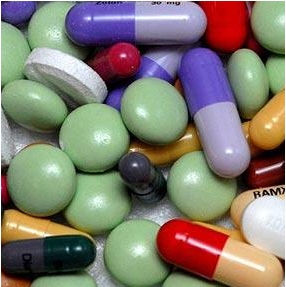
Pennsylvania DUI attorney Justin J. McShane, Esq. presents his lecture "Defending DUI Drug Cases" in Hartford, CT in December 2009. In Part 3: "Pharmacology," expert DUI Attorney McShane explains the differences, both in testing procedure and impairment determination, between DUI Alcohol and DUI Drug cases. The McShane Firm is the premiere DUI/DWI law firm in Harrisburg, PA. For more information, visit themcshanefirm.com.


-Justin J. McShane, Esquire, Pennsylvania DUI Attorney

I am the highest rated DUI Attorney in PA as Rated by Avvo.com

You can follow me on Twitter, Facebook or Linkedin

Harrisburg DUI Lawyer Justin J McShane Esquire earns
criminal law certification throguh NBTA

Board Certified Criminal Trial Advocate
By the National Board of Trial Advocacy
A Pennsylvania Supreme Court Approved Agency

Defending DUI Drug Cases: Part 2 from PA DUI attorney Justin J. McShane

Pennsylvania DUI attorney Justin J. McShane, Esq. presents his lecture "Defending DUI Drug Cases" in Hartford, CT in December 2009. In Part 2: "Drug Identification and Quantification," expert DUI Attorney McShane details the difference between impaired and metabolite states, and explains why "the numbers by themselves are meaningless or junk." The McShane Firm is the premiere DUI/DWI law firm in Harrisburg, PA. For more information, visit TheMcShaneFirm.com.


-Justin J. McShane, Esquire, Pennsylvania DUI Attorney

I am the highest rated DUI Attorney in PA as Rated by Avvo.com

You can follow me on Twitter, Facebook or Linkedin

Harrisburg DUI Lawyer Justin J McShane Esquire earns
criminal law certification throguh NBTA

Board Certified Criminal Trial Advocate
By the National Board of Trial Advocacy
A Pennsylvania Supreme Court Approved Agency

Defending DUI Drug Cases: Part 1 from PA DUI attorney Justin J. McShane

Pennsylvania DUI attorney Justin J. McShane, Esq. presents his lecture "Defending DUI Drug Cases" in Hartford, CT in December 2009. In this introduction, expert DUI Attorney McShane presents an overview of how DUI lawyers can use forensic science to successfully defend clients accused of DUI-D cases. The McShane Firm is the premiere DUI/DWI law firm in Harrisburg, PA. For more information, visit TheMcShaneFirm.com.


-Justin J. McShane, Esquire, Pennsylvania DUI Attorney

I am the highest rated DUI Attorney in PA as Rated by Avvo.com

You can follow me on Twitter, Facebook or Linkedin

Harrisburg DUI Lawyer Justin J McShane Esquire earns
criminal law certification throguh NBTA

Board Certified Criminal Trial Advocate
By the National Board of Trial Advocacy
A Pennsylvania Supreme Court Approved Agency

What's more important Sports or Courts?

Olympic doping lab world's most sophisticated

A dope-testing lab considered the most sophisticated in the world is up and running for the 2010 Winter Olympics in Vancouver.

I read this article the other day and it got me thinking: What's more important making sure a cheater doesn't win a race or making sure an innocent person is not convicted of a serious crime like DUI?

I have blogged before about the shoddy nature of our nation's forensics labs:

Winter Olympics and DUI TestinThere are more sophisticated ways of testing that aren't being used, procedures that are not being followed, and there are better ways to monitor DUI and drug testing.  Over the course of the countless DUI trials I have fought, I have seen the whole gambit of tainted blood and urine tests which end up producing results that if accepted would have convicted many of these innocent people.  Fortunately, as a premier forensics and DUI expert I was able to catch these flaws.  However, everyday people are convicted because of these mistakes.

Take a look at this article. The world's most sophisticated testing lab has been set up for the Winter Olympics but not to ensure justice in our courts.  Think about it.  Canada is spending an enormous amount of resources to ensure cheaters don't win medals but our lawmakers turn a blind eye to the fact that our forensics system is broken and many innocent people have gone to jail because of it.  WHY?

Preserving the purity and sanctity of sports is important but ensuring "justice for all" is the fabric of our society.


Share/Bookmark


-Justin J. McShane, Esquire, Pennsylvania DUI Attorney

I am the highest rated DUI Attorney in PA as Rated by Avvo.com

You can follow me on Twitter, Facebook or Linkedin

Harrisburg DUI Lawyer Justin J McShane Esquire earns
criminal law certification throguh NBTA

Board Certified Criminal Trial Advocate
By the National Board of Trial Advocacy
A Pennsylvania Supreme Court Approved Agency

Why saying the sample was run on a gas chromatograph is nearly meaningless

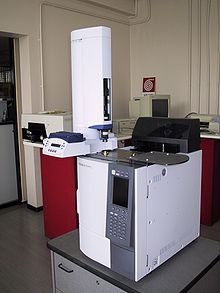
Saying the sampling was done on a Gas Chromatograph is like saying that you won a car.  Both description are useful in that they help differentiate. 

  • In the case of all vehicles, it is useful to distinguish cars from trucks or motorcycles.
  • Whereas in the case of chemical testing, it is useful to distinguish gas chromatography from enzymatic assay testing or breath testing.  

But neither initial descriptions give any idea of specifics.

  • In the case of cars, there are different makes, models  and years.
  • Whereas, in gas chromatography there are many different options.

This is why when you are a citizen among us who has been accused of a DUI and the magic number (i.e., the alleged BAC result) is derived from a purported Gas Chromatography result, you need to find a DUI lawyer who knows a lot about the scientific process and what precisely and in detail the configuration and the method of Gas Chromatography used.  You shouldn't settle for simply someone who has heard of it, but you deserve someone who is a near expert in Gas Chromatography.  So, ask some questions of your potential DUI lawyer.  See what level of familiarity and detail he/she may have.  If their description amounts to a simple answer like its "a car" in our analogy, then maybe you need to look elsewhere.

I had wrote very generally on Gas Chromatography before and the specific training that I had received through the American Chemical Society and Axiom Labs at:

Gas Chromatography and why is it is so important to Pennsylvania DUI arrests

I had further posted on Crimping a Headspace Vial in Gas Chromatography: How not putting the "lid on the jar" can lead to disaster in a DUI case and A large problem in Gas Chromatography: No uniform standard for GC run position or composition

Now let's take it to another level and start to look at the variations in configuration to turn the description of "a car" into something much more meaningful.  This post will focus on the various non-programmable hardware-related or configuration-related issues.  The specifics of the configuration.  A future post will focus on the programmable or process/protocol-related issues.

In terms of configuration the variables in modern gas chromatography for ETOH or drugs of abuse determination include:

Carrier gas:  In America typically helium is used as the inert gas used to "push" the analytes through the system; although hydrogen is the second most popular method.  [Blogger's note:  More will be written on this distinction and specifically on the need for blanks between unknown samples]

Harrisburg DUI Lawyer carrier gas  Harrisburg DUI Lawyer GC with hydrogen generator

(pictured above left:  a Gas Chromatograph with helium tank as the carrier gas; and above right:  a Gas Chromatograph with hydrogen generator-the blue box to the right)

Internal standard:  It is a substance added to achieve an "artificial peak" in chromatography when measuring an unknown and in analytical chemistry, it is a chemical substance that is added in a constant amount to samples, the blank and calibration standards in a chemical analysis. The ratio of the unknown analyte signal to the internal standard signal as a function of the analyte concentration of the standards and hence can achieve a known result.  Generally, in alcohol testing it is n-propanol, but for drugs of abuse in particular other internal standards can be used.  [Blogger's note:  In the future more will be written on the importance of this distinction and especially in terms of the salting out effect]

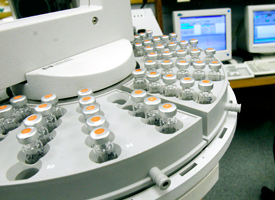
Injection type:  Direct injection versus headspace methodology versus autosampler  [Blogger's note:  In the future more will be written on the importance of this distinction]

 Harrisburg DUI Lawyer injector port for GC gas chromatography  Harrisburg DUI Lawyer with headspace autosampler

(pictured above to the left is an injection port where one may do a direct injection; and above right is an headspace autosampler) [to see an autosampler in action please go to: A large problem in Gas Chromatography: No uniform standard for GC run position or composition]

Harrisburg DUI Lawyer manual headspace sampler  Harrisburg DUI Lawyer GC headspace installed

(pictured above left is a manual headspace sampler; and pictured above right is an installed headspace autosampler on a gas chromatograph)

Column:  Not all columns are the same.  There are two basic types:  capillary versus packed.  Generally in modern gas chromatography for ETOH and drug of abuse testing, capillary columns are used.  However, there is no universal column (e.g., Restek BAC 1, Restek BAC 2, Agilent DB-ALC 1, Agilent DB-ALC 2, Rxi™-5ms, DB-5)  What type of capillary column is installed majorly affects specific performance.

 Harrisburg DUI Lawyer packed column GC2 Harrisburg DUI Lawyer packed column GC

(pictured above left:  uninstalled packed column; and pictured above right:  installed packed column inside of gas chromatograph)

Harrisburg DUI Lawyer uninstalled capillary column  Harrisburg DUI Lawyer with capillary column

(pictured above left:  uninstalled capillary column; and pictured above right:  installed capillary column inside of gas chromatograph)

Number of columns:  The gas chromatograph can be set up so as to accept a single column or two which is referred to as dual columns.  With dual column configuration duplicate testing is possible.

Harrisburg DUI Lawyer dual column inside

(pictured above:  a dual column configuration)

Detector:  Without a detector, a gas chromatograph is just a screening device as it can only denote separation between analytes of interest and not the quantification of those analytes.  The addition of a detector makes the qualitative measure achieved by the gas chromatograph itself (i.e., the separation characteristic) into a combination of qualitative measurement with the quantitative measurement (as achieved separately by the detector).  In gas chromatography there are so many possible detectors that are used, but primarily for ETOH and drugs of abuse testing of unknowns, flame ionization detectors (usually used in ETOH determinations) and/or mass spectrometry (usually used in drugs of abuse) is used.  With mass spectrometry different detectors are available such as Triple Quadrupole configuration.  [Blogger's note:  Much more will be written on this later]

Harrisburg DUI Lawyer GC-MS with autosampler  Harrisburg DUI Lawyer GC-MS opened

(pictured above left:  a gas chromatograph with a flame ionization detector using an autosampler; and pictured above right:  on the left an open mass spectrometer and on the right an open gas chromatograph)

Harrisburg DUI Lawyer FID flame ionization detector    Harrisburg DUI lawyer exploded view of flame ionization detector

(pictured above left:  an installed FID or Flame Ionization Detector; pictured above right:  an exploded view of flame ionization detector)

Multiple injectors and multiple detectors: There is no end to the configurations that one can develop.  There are GC-FID, GC-MS-MS.  One can have a GC with multiple injector ports too.

 Harrisburg DUI Lawyer 2 FID 2 columns and dual injector ports  Harrisburg DUI Lawyer Dual FIDs

(pictured above left:  2 FIDs 2 columns and dual injector ports; and pictured above right:  close up of dual Flame Ionization Detectors)

Harrisburg DUI Lawyer GC-MS-MS    Harrisburg DUI Lawyer dual injectors

(pictured above left:  a GC-MS-MS; pictured above right:  dual injector ports)

An overall perspective

Harrisburg DUI Lawyer inside of GC-FID oven (pictured above:  Can your DUI attorney identify the basics?  What do the different color arrows represent? If you are a good defense attorney go ahead and post the answer and get credit)


In order to determine whether or not a test is accurate, precise, traceable, reliable, repeatable, trustworthy and true, we must look at these differences.  In order to determine whether or not your DUI attorney knows what he or she is doing, then they must know all of this at a very minimum.

Share/Bookmark


-Justin J. McShane, Esquire, Pennsylvania DUI Attorney

I am the highest rated DUI Attorney in PA as Rated by Avvo.com

You can follow me on Twitter, Facebook or Linkedin

Harrisburg DUI Lawyer Justin J McShane Esquire earns
criminal law certification throguh NBTA

Board Certified Criminal Trial Advocate
By the National Board of Trial Advocacy
A Pennsylvania Supreme Court Approved Agency

A large problem in Gas Chromatography: No uniform standard for GC run position or composition

I try to learn everything that I can about analytical testing.  Not being a scientist and only being a lawyer, I am an outsider to this fascinating world.  I find that as I learn more, more questions present themselves.  As an outsider last year l learned something that really kind of surprised me. 

When Gas Chromatography is used and especially when an auto-sampler for Headspace Gas Chromatography (HSGC) is used, there is no universal standard operating procedure as to what headspace vial goes into what position and what minimum standards comprise a auto-sampler Headspace Gas Chromatography run.

(above video an auto-sampler)

But why does this matter?

Harrisburg DUI Lawyer knows headspace gas chromatography

As a nationally known DUI attorney and having received forensic expert training, I get weekly calls from colleagues from Georgia, Tennessee, New Hampshire, California, Arizona and elsewhere about Gas Chromatography.  I love it. I thank my colleagues for the trust in consulting with me.  It is amazing to me to see the variation.  The variation is not only from state to state, but also from labs within a state and yes, even from technicians within one lab.  Wow!

So if there is no uniformity, then there can be no consistency.  There are large issues that can emerge with this approach.  I have personally seen the following:

  1. An entire run without a single blank (Pennsylvania)
  2. An entire run without positive controls (New Hampshire)
  3. An entire run without a separation matrix that would prove separation between methanol, ethanol, isopropanol or butanol at the very least (Georgia, Tennessee)
  4.  No calibrators within the run (Texas)
  5. A "historical calibration curve" used as a calibration curve where the columns were actually replaced between the columns that produced the "historical calibration curve" and the columns that were used to test this unknown (Pennsylvania)
  6. A lack of blanks run between unknowns to prove lack of carry-over effect (everywhere) [Blogger’s note: a more comprehensive post on this will follow]


Share/Bookmark


-Justin J. McShane, Esquire, Pennsylvania DUI Attorney

I am the highest rated DUI Attorney in PA as Rated by Avvo.com

You can follow me on Twitter, Facebook or Linkedin

Harrisburg DUI Lawyer Justin J McShane Esquire earns
criminal law certification throguh NBTA

Board Certified Criminal Trial Advocate
By the National Board of Trial Advocacy
A Pennsylvania Supreme Court Approved Agency


Metrology in DUI prosecution

Harrisburg DUI Lawyer referenceMetrology is the body of science surrounding measurement or how we know for certain or for as near as certain as scientifically possible that some measurement is in fact that quantitative measure.

It is the very essence of measurement.  Because if we do not know that some measurement is accurate, precise and true, then we know nothing.  We have no frame of reference.  No basis for comparison.

This concept with analytical devices is achieved when known standards are used.  Stated differently, an instrument's bias, precision, and accuracy can be measured by calibration to a traceable standard..

What this really all involves is the concept of traceability.

But where do these standards come from?

In DUI prosecution, the concept of traceability is involved in any form of calibration, internal standards, positive controls, negative controls or reference solutions used in achieving a Blood Alcohol Content result.

There are two (2) basic ways that the concept of traceability can be legitimately achieved:

  1. NIST standards
  2. USP grade raw materials

NIST is an acronym that stands for the National Institute of Standards and Technology which is part of United States Department of Commerce.  They certify weights and measures.  Many state's have a like agency.


Harrisburg DUI Lawyer USP-NFUSP is an acronym that stands for United States Pharmacopeia which is a non-government entity that makes commercially available standards.  USP sets standards for the quality, purity, strength, and consistency of these products. They issue certificates to insure that a purchased product is in fact what it purports to be.  Certified Reference Materials (CRMs) represent the next generation of exceptional quality USP Reference Standards. CRMs have undergone additional metrologically based testing and statistical analysis to meet both USP's stringent criteria and guidelines established by the International Organization for Standardization (ISO).

Why is this important?

In analytical testing whether it is breath, blood or urine we have an unknown which is the amount of EOTH or drugs of abuse in the substrate (breath, blood and urine of the accused DUI suspect), we can only know how much it is if it is compared against a known amount from a standard.  It is this comparison between the known and the unknown that gives us the amount of the unknown to report.

So if calibrators, internal standards, positive controls, negative controls or reference solutions are not NIST traceable or comprised of USP grade raw materials, then there is no way to know, in a scientifically responsible way, what the unknown really is.


Share/Bookmark


-Justin J. McShane, Esquire, Pennsylvania DUI Attorney

I am the highest rated DUI Attorney in PA as Rated by Avvo.com

You can follow me on Twitter, Facebook or Linkedin

Harrisburg DUI Lawyer Justin J McShane Esquire earns
criminal law certification throguh NBTA

Board Certified Criminal Trial Advocate
By the National Board of Trial Advocacy
A Pennsylvania Supreme Court Approved Agency

Why forensic science testing for DUI BAC determination is the silly sister of analytical science: Good Laboratory Practices

I have written before, perhaps rhetorically:  Why if someone is allowed full due process of law are we also not entitled to due process of science?

It seems backward.  Law at the expense of science or science at the expense of law, doesn't it?

One would think rationally that we would be entitled to full scientific safeguards and best practices, but in the forensic environment generally and in the DUI testing for BAC analysis, it is sorely lacking.

It seems that as a society we are more concerned with the prospect of having a new pharmaceutical wrongly introduced into the market than we are in getting a conviction wrong.

As a proof of the above, just look at any pharmaceutical lab and the rigorous documentation and process application validity that goes into developing and testing a pharmaceutical before it is allowed into production and distribution.  In that industry it is called "Good Laboratory Practices" (GLP).  This is to be contrasted to the near opposite of that which is forensic testing.

Harrisburg DUI Lawyer Good Laboratory Pracitces GLP

In the clinical and research arena, the phrase Good Laboratory Practice or GLP generally refers to a system of management controls for laboratories and research organizations to ensure the consistency and reliability of results as outlined in the Organization for Economic Co-operation and Development (OECD) Principles of GLP and national regulations.

Good Laboratory Practice (GLP) embodies a set of principles that provides a framework within which laboratory studies are planned, performed, monitored, recorded, reported and archived.

There is no equivalent to this in forensic science generally and specifically in DUI forensic testing for BAC determinations.  Sadly there are no national or international standards.  Each state and sometimes each jurisdiction within a state is allowed to setup and use in whatever manner they see fit, for their DUI testing for BAC analysis.  Crazy, huh?


Share/Bookmark


-Justin J. McShane, Esquire, Pennsylvania DUI Attorney

I am the highest rated DUI Attorney in PA as Rated by Avvo.com

You can follow me on Twitter, Facebook or Linkedin

Harrisburg DUI Lawyer Justin J McShane Esquire earns
criminal law certification throguh NBTA

Board Certified Criminal Trial Advocate
By the National Board of Trial Advocacy
A Pennsylvania Supreme Court Approved Agency


Why it is right to be a modern day skeptic: The need to continue to challenge sacred cows: Paradigm Shift

Harrisburg DUI Lawyer sacred cow

(Pictured above:  A sacred cow)

A sacred cow is defined as "an object or practice which is considered immune from criticism, especially unreasonably so."

They exist all around us.  Some healthy.  Most are not.  It is vitally important for the evolution of man and science to identify, examine and challenge sacred cows. 

In short to be a scientist.

This begins with the idea of accepting only the null hypothesis as truth before you accept correlation or causation.  The null hypothesis typically proposes a general or default position, such as that there is no relationship between two quantities, or that there is no difference between a experimental group and the control group.  One then designs a series of statistically and scientifically valid tests to robustly challenge the null hypothesis not to adopt it, but rather with an eye towards disproving the null hypothesis.

For example, imagine flipping a coin three times for three heads and then forming the opinion that we have used a two-headed trick coin. Clearly this opinion is based on the premise that such a sequence is unlikely to have arisen using a normal coin. In fact, such sequences (three consecutive heads or three consecutive tails) occur a quarter of the time on average when using normal unbiased coins. Therefore, the opinion that this coin is two-headed has little support. Formally, the hypothesis to be tested in this example is "this is a two-headed coin." One tests it by assessing whether the data contradict the null hypothesis that "this is a normal, unbiased coin." Since the observed data arise reasonably often by chance under the null hypothesis, we cannot reject the null hypothesis as an explanation for the data, and we conclude that we cannot assert our hypothesis on the basis of the observed sequence.

So, it is healthy and natural to accept no proposition as proven until it has rigorously been examined as if under a microscope.  In the court of law, there should be no scared cows.

Harrissburg DUI Lawyer microscope

So, if we accept the proposition that there are no sacred cows and that we must identify, challenge, test or challenge these sacred cows of science in the Courtroom, what can be the consequence?

The consequence could be a paradigm shift.

One of my personal all time favorite books is Thomas Kuhn's The Structure of Scientific Revolution, it was published in 1962 and really codified the concept of "paradigm shift".  He postulated and observed that scientific advancement is not evolutionary, but rather is a "series of peaceful interludes punctuated by intellectually violent revolutions", and in those revolutions "one conceptual world view is replaced by another".  Driven by agents of change, a Paradigm Shift is a change from one way of thinking to another.  Sometimes even violently so in the face of institutional or systemic resistance.  It is a revolution, a transformation, a sort of metamorphosis.  It just does not happen, but rather it is forced typically over objection of the status quo.
 

As identified by Scientific American magazine (I added an additional 5 to their list), some of the "classical cases" of paradigm shifts are as follows:

In "hard sciences":

  • The transition from a Ptolemaic cosmology to a Copernican one.
  • The acceptance of the theory of biogenesis, that all life comes from life, as opposed to the theory of spontaneous generation, which began in the 17th century and was not complete until the 19th century with Pasteur.
  • The transition between the Maxwellian Electromagnetic worldview and the Einsteinian Relativistic worldview.
  • The transition between the worldview of Newtonian physics and the Einsteinian Relativistic worldview.
  • The development of Quantum mechanics, which redefined Classical mechanics.
  • The acceptance of Plate tectonics as the explanation for large-scale geologic changes.
  • The development of absolute dating
  • The acceptance of Lavoisier's theory of chemical reactions and combustion in place of phlogiston theory, known as the Chemical Revolution.
  • The acceptance of Lamarck's theory of evolution to replace creationism
  • The acceptance of Charles Darwin's theory of natural selection replaced Lamarckism as the mechanism for evolution.
  • The acceptance of Mendelian inheritance, as opposed to pangenesis in the early 20th century.
  • Moving from Newtonian physics to Relativity and Quantum Physics.

In other contexts:

  • The transition from a hunter-gatherer lifestyle to an agricultural one.
  • The widespread use of the printing press publishing works in the vernacular of the region as opposed to handwritten and copied texts published only in Latin.
     

As we continue to creep and settle into the second decade of the 21st century, some needed paradigm sifts in DUI jurisprudence are as follows:

  • It is high time for all of us to insist upon modern 21 century be used in our Courts. Infrared breath test spectrometry that only detects at wave lengths that are non-specific to ETOH and have insufficient Mouth Alcohol Detectors that do not take into account that every person's physiology is different and rely instead on a incorrect assumption that everyone's partition ratio is the same needs to be banished to the relics area along with lead bullet analysis, forensic odentology and other psudeo or para forensic endeavors.
  • Ending the acceptable reliance by the Court's upon the use of enzymatic assay testing to determine BAC based on colormetric/photospectrographic analytical devices as it is an indirect measure of the uptake of NAD to NADH and only singly measures this uptake at a single wavelength that is non-specific to ETOH (at the 340 wavelength) on the spectrum.
  • The use and reliance on solely a police officer's opinion as to intoxication where no video tape exists to verify the claims of the officer.
  • When Gas Chromatography results are used, the failure to assure that there is no carry-over effect by running a blank immediately before the suspect sample must become the standard and the norm.
  • Forcing forensic science and its presentation out of the hands of law enforcement and into the hands of true credentialed and formally trained neutral scientists who exercise only within the scope of their formal training.
  • The use of blinded proficiency based testing on all technologists that is monitored and refereed by independent third parties.
  • The reporting of uncertainty in all results using accepted metrological principles.
  • The monitoring of all state expert witnesses in terms of the truthfulness and the candor of their testimony by a panel of independent scientists in the respected fields of testimony.
  • Demonstrated validity and robustness of all processes used in the field of breath testing and blood testing for achieving ETOH results prior to their continued introduction into Court.

Paradigm shifts are well within the natural order of things and can only occur if we reject the concept that sacred cows should exist.  It comes through agents of change and the use of skepticism and science.  It is high time, we take a look at these sacred cows in the Courtroom when it comes to DUI.  Don't you agree?


Share/Bookmark


-Justin J. McShane, Esquire, Pennsylvania DUI Attorney

I am the highest rated DUI Attorney in PA as Rated by Avvo.com

You can follow me on Twitter, Facebook or Linkedin

Harrisburg DUI Lawyer Justin J McShane Esquire earns
criminal law certification throguh NBTA

Board Certified Criminal Trial Advocate
By the National Board of Trial Advocacy
A Pennsylvania Supreme Court Approved Agency